Title

Orthotopic T cell receptor replacement by advanced non-viral cell engineering

Research Area

Hematology, Oncology, Clinical Immunology, Microbiology, Immunology
Project Summary

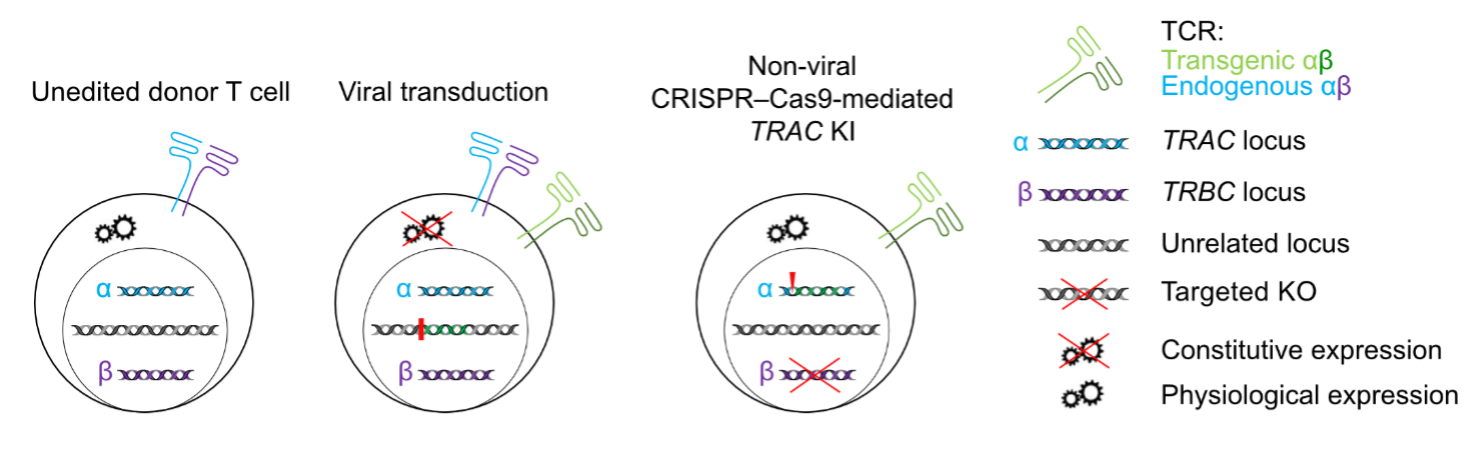
During the last funding period we have developed and further characterized in-depth CRISPR/Cas9-guided orthotopic T cell receptor (TCR) replacement (OTR). We demonstrated that OTR results in engineered T cells with physiological TCR expression, predictable functionality and largely improved epitope-specific cytotoxicity. TCRs recognize a plethora of unique antigens and associated epitopes. Besides necessary reactivity to self-epitopes, which provides important survival signals and may influence tissue tropism to some extent, a substantial fraction of encountered foreign or neo-epitopes can be recognized by individual TCRs. Thus, every TCR harbors a unique (cross-)reactivity profile. Natural T cell responses are polyclonal, entailing many different TCRs even within defined antigen-reactive T cell populations. Out of these, few TCRs with particular characteristics (e.g. high affinity for a target epitope, cross-reactivity for epitope-escape variants, multi-epitope target cell reactivities) seem to be particularly important for immediate or long-term immune protection.

For example, in patients with curative T cell responses upon tumor-infiltrating lymphocyte (TIL) therapy, CD8+ T cell clones with multi-epitope reactive TCRs have recently been identified. However, the probability that such optimal combinations of multi-reactivities are present within an individual’s repertoire are stochastic and relatively low. In addition, extended in vivo high-affinity antigen-encounter can induce immuno-senescence, thereby further shaping the composition of antigen-specific T cell populations and negatively interfering with immune protection. Therefore, engineering of defined multi-epitope or affinity-adjusted recombinant TCR T cells with high protectivity, low risk for unrecognized epitope-escape and/or better functional maintenance could have great potential to improve future T cell-based therapies. Therefore, we plan to address the following challenges during the next funding period: 1. OTR- and AI-guided identification of TCRs harboring cross-reactivities against immune-escape epitope variants and defined other (potentially more distantly related) epitopes. 2. Development of in vitro and in vivo assays to explore the protective capacity of OTR-generated multi-epitope reactive T cells. 3. Investigation of dual TCRalpha chain expression for next generation TCR engineering and differentiation-dependent expression of multi-epitope and affinity adjusted T cells.
More