
Title
Integrative and immunoprofiling analysis for single-cell and spatial genomics
Bioinformatics and Theoretical Biology
Project Summary
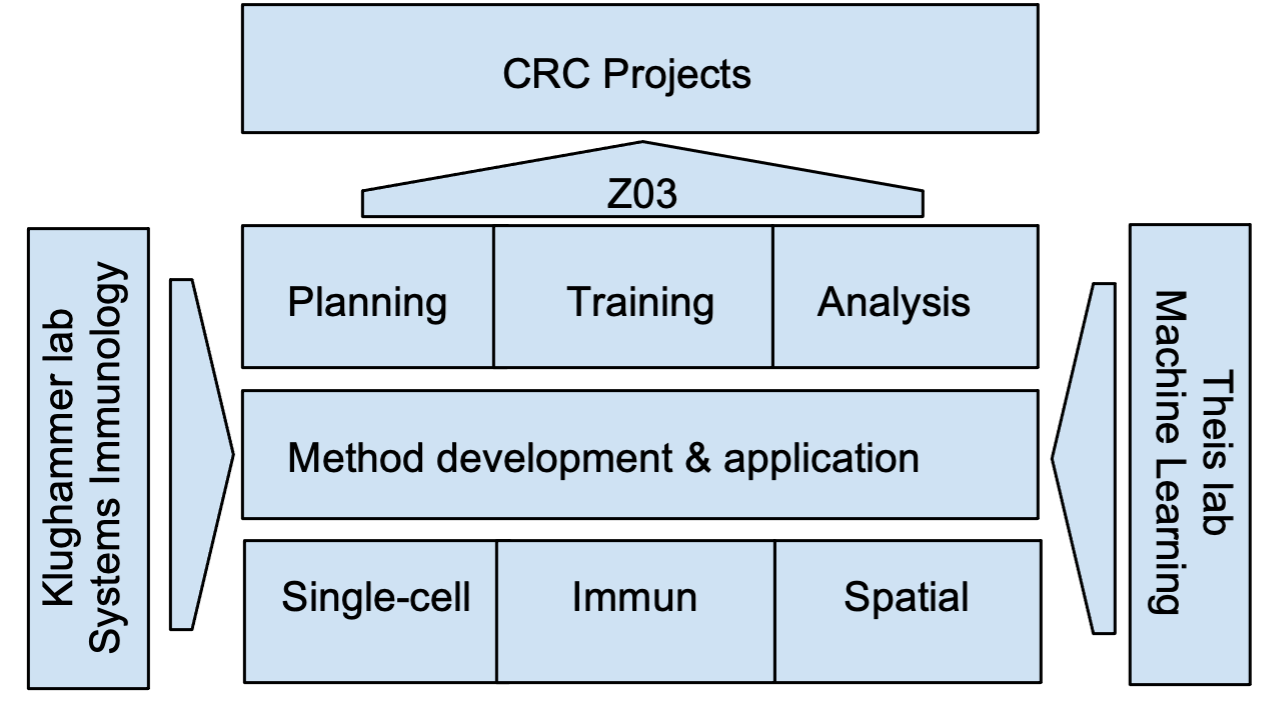
In Z03 the Theis Lab (Machine Learning in Single-Cell Genomics) and the Klughammer Lab (Systems Immunology) join forces to support CRC projects with technological and analytical expertise for single-cell and spatial omics.
Optimizing the efficacy and safety of engineered lymphocytes for cancer immunotherapy and chronic viral infections requires a comprehensive view of how immune cells transition between functional states. Building on established single-cell methodologies, we now propose to integrate spatial transcriptomics, spatial immunomics, and immune receptor profiling to capture the context‐dependent interactions that govern therapeutic outcomes. By developing and applying cutting‐edge bioinformatics and machine learning approaches, such as trajectory inference, RNA velocity, and deep learning‐based immune profiling, the Z03 project will support the CRC in deciphering key mechanisms of lymphocyte activation, exhaustion, persistence, and antigen specificity in diverse clinical and pre-clinical contexts.
We will tailor novel computational pipelines to (i) identify and characterize the molecular states of CAR-T and TCR-T cells under diverse experimental and clinical conditions, (ii) integrate multi-modal omics data (including single-cell, spatial, and immune receptor sequencing) into a cohesive framework that delineates immune cell identity and clonal dynamics, and (iii) map the spatial organization of immune-tumor interactions to reveal how cell-cell communication and tissue architecture affect lymphocyte function. Our efforts will also extend to data harmonization and the provision of standardized workflows, enabling CRC TRR projects to build robust, high-quality datasets that guide the rational design of next-generation immunotherapies.
By delivering advanced computational tools and novel insights into engineered lymphocytes’ behavior, the Z03 project will support immune engineering strategies throughout the consortium. Our integrated approach ensures that crucial aspects of immune cell state, location, and receptor specificity are jointly analyzed, providing a powerful platform towards overcoming current challenges in cell therapy and supporting the quest for safer, more effective treatments.