Project Summary
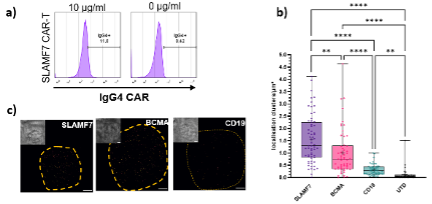
This project links lymphocyte engineering to advanced imaging technologies. We will use single-molecule sensitive super-resolution microscopy (SRM) methods including dSTORM, (TDI)-DNA-PAINT, 3D live-cell lattice light-sheet microscopy (LLS) and supported lipid bilayers to visualize how changes in the design of engineered cell surface receptors influence the ability of T cells to interact with target cells. This is exemplified by our recent demonstration that anti-CD19 CAR-T cells can still recognize seemingly CD19 negative (as judged by flow cytometry) myeloma cells. Moreover, we will generate novel insights into the composition of the CAR immunological synapse at a single-molecule level.
The first part of the proposed work program aims to develop a method for refined single-molecules-sensitive 3D imaging of whole cells combining LLS with an improved DNA-PAINT method (TDI-DNA-PAINT). 3D-LLS-TDI-DNA-PAINT will be used to unravel the 3D molecular architecture of the CAR/TCR immunological synapse (Aim 1). In this context, we do not only focus on the CAR, but also on its interaction partners and the actin cytoskeleton. Aim 2 is focusing on the generation of a platform for sensitivity determination. While cell-line based models have proven to work well for high to intermediate antigen counts, simulating (ultra-) low levels of antigen expression has thus far been challenging. We therefore will implement a modular system in which a supported lipid-bilayer will be used for exact and finely graded determination of antigen thresholds necessary for initiation of different T cell effector functions. We will systematically compare the most prevalent existing CAR formats regarding their respective antigen thresholds, and optimize CAR-T cell function by altering CAR components and investigate the impact of these substitutions on the antigen threshold.
More