
Title
Novel strategies to enhance adoptive T cell therapy for intracranial pediatric solid tumors
Research Area
CAR-T cell therapy
Project Summary
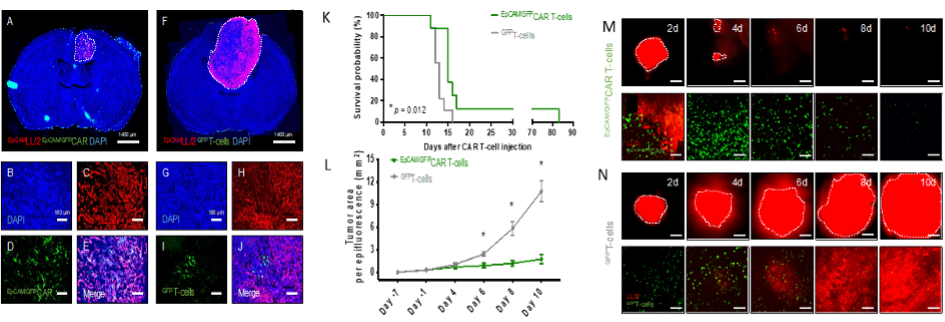
In the treatment of brain malignancies, T cells expressing chimeric-antigen-receptors (CARTs) have failed to induce lasting tumor control. To a large extent, this has been attributed to insufficient infiltration, activation and persistence of CARTs within the heterogeneous and immunosuppressive tumor stroma. In this project, we therefore aim to optimize the migratory and tumoricidal properties of CARTs in the treatment of brain tumors. To achieve this goal, we will utilize a set of approaches that investigate the functional and transcriptional properties of CARTs directly ex vivo.
Thereby, we aim to identify novel candidate molecules that we will engineer and test for their in vivo therapeutic capacity. In a first step, we aim to characterize migration, interaction and killing capacity of individual CARTs within the diverse brain tumor microenvironment using long-term in vivo multiphoton microscopy (IV-MPM) (von Baumgarten et al., 2011, Mulazzani et al, 2019). For this purpose, two syngeneic, orthotopic mouse models of cerebral malignancy, primary CNS lymphoma (PCNSL) and glioblastoma (GBM) as well as respective murine CARTS (anti-CD19 and anti-Her2) will be used.
In a second step, we aim to identify and validate candidate genes for successful migratory engineering. We will compare the whole transcriptome of deeply infiltrating CARTs to that of superficially restricted CARTs harvested from the same tumor or tumor entity. To achieve this, CARTs expressing a photo-convertible fluorophore will be used. After photo-activation using in vivo multiphoton confocal laser scanning microscopy (MPLSM), CARTs will be sorted according to their color-coded positional history and will further be processed for RNA sequencing (RNAseq) on bulk and later single-cell level.
Finally, we aim to modify infiltration depth, motility and persistence of individual CARTs in brain tumors by retroviral combinatorial engineering of an additional profile of fluorescently-labeled migration-associated receptors. Using an established optical barcoding approach (Grasmann et al, 2019), the engineered receptor profile of individual tumor infiltrating CARTs can be assessed directly via MPLSM and/or flow-cytometry. Promising receptor combinations will then be tested against standard CART therapy for efficiency and durability of tumor regression.
In a second step, we aim to identify and validate candidate genes for successful migratory engineering. We will compare the whole transcriptome of deeply infiltrating CARTs to that of superficially restricted CARTs harvested from the same tumor or tumor entity. To achieve this, CARTs expressing a photo-convertible fluorophore will be used. After photo-activation using in vivo multiphoton confocal laser scanning microscopy (MPLSM), CARTs will be sorted according to their color-coded positional history and will further be processed for RNA sequencing (RNAseq) on bulk and later single-cell level.
Finally, we aim to modify infiltration depth, motility and persistence of individual CARTs in brain tumors by retroviral combinatorial engineering of an additional profile of fluorescently-labeled migration-associated receptors. Using an established optical barcoding approach (Grasmann et al, 2019), the engineered receptor profile of individual tumor infiltrating CARTs can be assessed directly via MPLSM and/or flow-cytometry. Promising receptor combinations will then be tested against standard CART therapy for efficiency and durability of tumor regression.